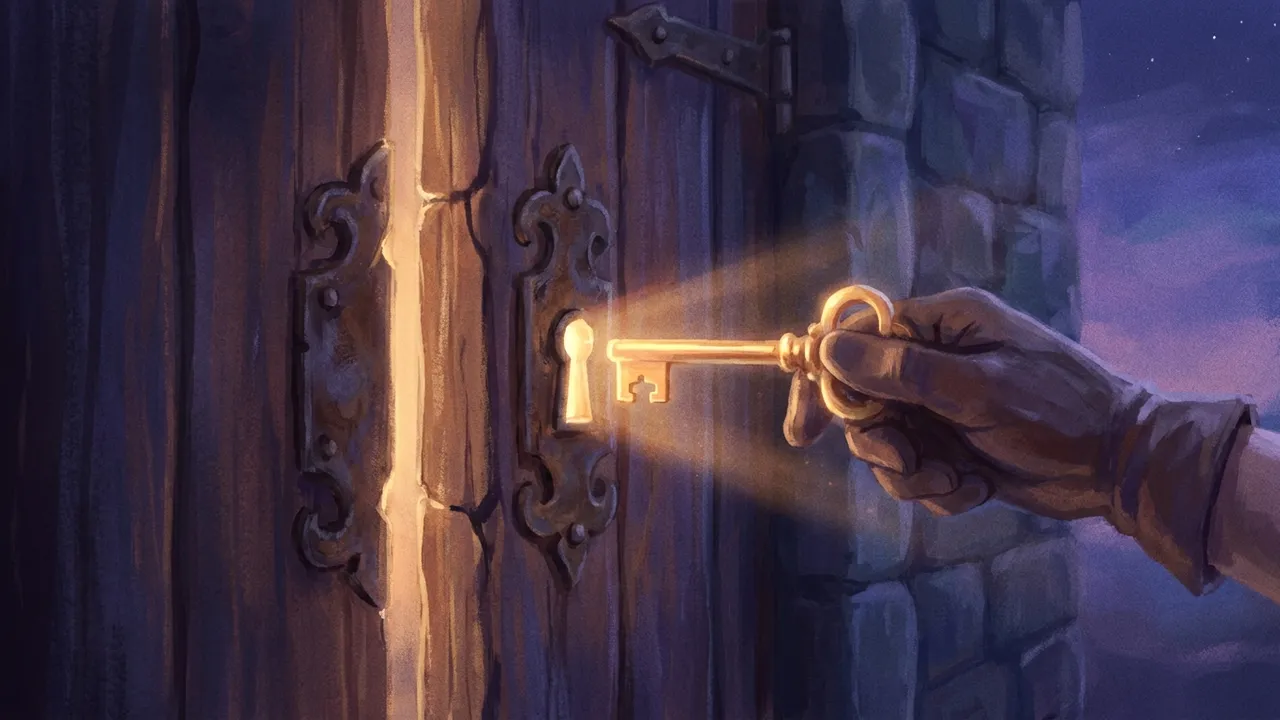
A dream about keys usually points to access: a door you want opened, a problem you want solved, or a part of life you feel shut out of or in charge of. The feeling in the dream decides the meaning, because a key found with relief says something very different from a key that will not turn. Keys are small objects that carry big questions about trust, security, privacy and opportunity, which is why they turn up when you are standing at a decision point, even a quiet one.
What does a dream about keys mean?
At its simplest, a key is a tool for getting through a barrier. So in dreams it tends to stand for permission, ability or opportunity: the sense that you can open something, or that someone else holds the power to open it for you. Whether you are holding the key, searching for it or handing it over tells you where you feel that power sits.
Context shifts the reading a great deal. A bunch of keys on your own belt often reflects responsibility, the feeling of being the person everyone relies on. A single unfamiliar key can feel more like a mystery or a hint, something you have not yet found the lock for. A key you are guarding may point to secrets, or to the need for privacy.
Pay attention to the mood when you wake. Calm and curious usually suggests readiness. Panicky and rushed suggests pressure, fear of missing out, or worry about being locked out of something that matters, such as a job, a relationship or a place to live.
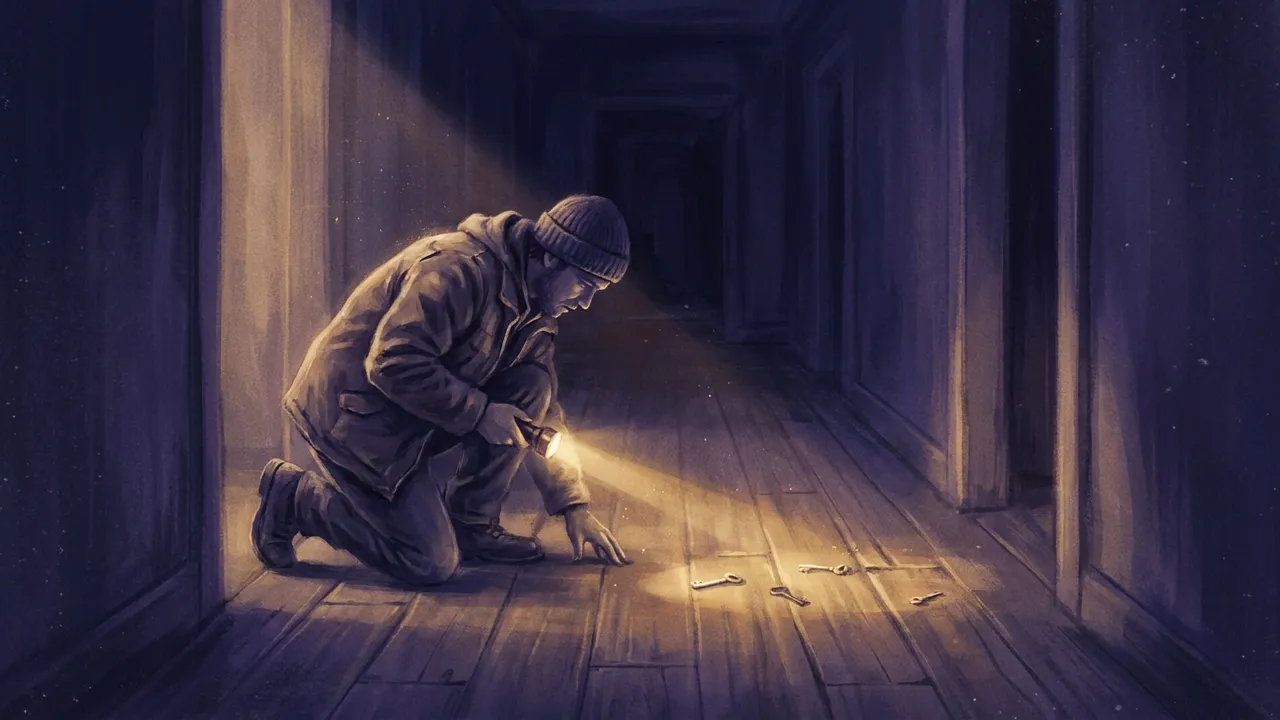
What does it mean to dream about losing your keys?
This is probably the most common version, and it is rarely about the keys themselves. You are patting your pockets, emptying a bag, retracing steps through a house that keeps changing shape. Waking up, you feel the same low dread you feel in real life when you are already late.
Lost keys often mirror a sense of having mislaid something you need: confidence, a plan, a role, or control over a situation that has become crowded. People tend to report it around job changes, moves, exams, new parenthood or after a stretch of too many commitments. The dream may be pointing at overload more than at loss.
Ask what you would be locked out of if you never found them. The car may mean independence, the front door may mean safety, and the office key may mean your standing at work. Your answer usually names the real worry.
What does finding a key in a dream mean?
Finding a key tends to feel good, even when the key is odd: rusty, oversized, lying in the grass or tucked in the pocket of an old coat. It often signals that a solution or option is closer than you assumed. You may already hold the answer and not have recognised it.
Details matter. A golden or gleaming key can suggest value you are starting to recognise in yourself or in a opportunity. An old, worn key may connect to the past, a family matter or a skill you set aside years ago. Finding a key but having no idea what it opens often reflects a feeling of readiness without direction.
If you woke up curious rather than relieved, treat the dream as a prompt. Something is waiting for you to try it, and the dream is nudging you to look for the lock.

Why does the key not fit or the lock will not turn?
Few dream frustrations are as precise as this one. You push the key in, jiggle it, try the other side, and the door stays shut. Sometimes the key is the wrong shape, sometimes it snaps, and sometimes the lock has been changed.
This often shows up when you are putting effort into something that is not responding: an application, a stalled conversation, a project that keeps hitting the same wall. It can ask whether you are using the right approach, or whether the door you are pushing is really the one meant for you.
It can also carry resentment. If someone else changed the locks in the dream, consider whether you feel shut out of a family, a team or a friendship. The dream does not say the door is closed forever, only that this particular key is not working.
What if you open a door with a key in your dream?
Opening a door with a key is the satisfying ending many people hope for. The lock gives, the handle moves, and what lies beyond matters: a bright room suggests welcome and possibility, a dark corridor suggests uncertainty you are still willing to face.
Notice whose door it is. Opening your childhood home may point to memory and old patterns. Opening a stranger's house can reflect curiosity about parts of yourself you rarely visit. Unlocking a chest, diary or drawer often speaks to secrets, either yours or those you are ready to look at.
If you hesitated with the key in the lock, that hesitation is worth remembering. It may show you are not as sure about the change as you say you are.
Is there a psychological meaning behind keys dream interpretation?
Carl Jung treated dream objects as symbols that point toward something the conscious mind has not fully absorbed. In that framework, a key can stand for a way into the unconscious, a piece of understanding that lets you open a part of yourself that has been closed. Doors and locks are the other half of the picture: the boundaries you keep around what you do not want to look at.
Sigmund Freud read many locked and unlocked images through the lens of desire and restraint, and keys appear in classic psychoanalytic writing as symbols of sexuality and intimacy. Many modern readers find that reading too narrow, and it is only one possibility. A key dream is as likely to be about work, money or trust as about anything romantic.
Present-day dream research generally suggests dreams draw on what is occupying your mind and emotions, often replaying everyday worries in symbolic form. Keys are a daily object, so they are a natural carrier for stress about being prepared, being locked out or being responsible. None of this proves a fixed meaning. It simply invites you to match the dream against what is going on in your life.
What do keys mean in the Bible, Islamic and Hindu traditions?
In the Christian tradition, keys carry strong images of authority. In Matthew 16:19, Jesus speaks of giving Peter the keys of the kingdom of heaven, and in Revelation 1:18 he holds the keys of death and Hades. Isaiah 22:22 speaks of the key of the house of David placed on a servant's shoulder. Many Christian readers therefore take a key dream as being about spiritual authority, responsibility, or a door God may be opening or closing, echoing Revelation 3:8, where an open door is set before a faithful church.
In classical Islamic dream books attributed to Ibn Sirin, keys are often linked with provision, knowledge, and access to something good, and some interpretations tie them to trust or a responsibility being placed in your care. The Quran also speaks of God holding the keys of the unseen. These are traditional readings, and interpreters stress that the dreamer's circumstances and character shape the meaning.
In Hindu contexts there is no single fixed reading of keys in dreams, but they are commonly associated with opening opportunity, with wealth kept safe, and with the household keys traditionally held by the woman of the home as a sign of her place in the family. Some readers also connect a key with spiritual knowledge that opens the way to liberation. Treat these as cultural associations, not rules.
What should you ask yourself after a dream about keys?
Start with the plain facts: whose keys were they, what did they open, and did you get through? Then name the feeling at the moment of the key, whether that was relief, panic, shame or curiosity. The feeling is usually closer to the truth than the object.
Next, look for the real-life lock. Is there a decision you are circling, a conversation you have not started, or a space you want access to? Also ask what you are protecting. Keys guard as much as they open, and the dream may be about boundaries.
For a short journaling exercise, write three lines. First, describe the key in one sentence. Second, finish this sentence: the door I most want to open right now is... Third, write one small action that would be the equivalent of turning that key this week. Keep it modest and specific.
If the dream recurs, keep a note of what changes each time. A key that gradually starts to fit often tracks real progress.
When is a recurring dream about keys worth talking about?
Most key dreams are ordinary and fade within a day or two. If the same dream returns night after night, leaves you anxious, or is tied to a period of heavy stress, it can help to talk it through with someone you trust.
If it is affecting your sleep or mood, a doctor or a qualified counsellor can help you sort out what is going on. Sharing it is not a sign that something is wrong with you. Often, saying the dream aloud is enough to take some of its weight away.
Quick tips
- Write down the dream as soon as you wake, including what the key looked like and what it was meant to open. Small details often matter most.
- Match the dream to one real-life situation where you feel blocked or responsible, and consider one practical step you could take this week.
- If you follow a faith tradition, you may find it helpful to reflect on the dream alongside its teachings, while remembering that the meaning for you depends on your own circumstances.
Frequently asked questions
What is the keys dream meaning in simple terms?
Keys in dreams usually stand for access, opportunity, control or responsibility. Finding or using one tends to feel hopeful, while losing one or failing to open a lock points to stress or feeling blocked. Your own feelings in the dream matter more than any list of meanings.
Is dreaming about keys good or bad?
It is neither by default. A key that opens a door easily is often read as positive, and a lost or broken key as a sign of worry, but even the stressful versions can show you what you care about. Treat it as information rather than a verdict.
What does dream interpretation keys say about a bunch of keys?
A full ring of keys often reflects many responsibilities, or the feeling of being the one who holds things together. It may also suggest that you have more options than you are using. If the ring was heavy or tangled, that can hint at being overburdened.
What does it mean to dream of someone giving you a key?
Being handed a key often relates to trust, permission or a new role. It may reflect a real invitation, or a wish for someone to let you in. How you felt taking it, whether proud, nervous or reluctant, shows how ready you are.
What does it mean to dream of a golden key?
A golden key is commonly read as something valuable becoming available, such as a skill, a chance or a deeper understanding. In Christian reading it may echo biblical imagery of authority and open doors. It is a symbolic image, not a prediction.
Why do I keep dreaming about losing my keys?
Repeated lost-key dreams often appear during times of pressure, change or too many demands. The dream may be echoing a fear of being unprepared or locked out of something important. Noticing what is currently stretching you thin usually helps.